

The demise of the Egham Races
By Dr Geoff Meddelton
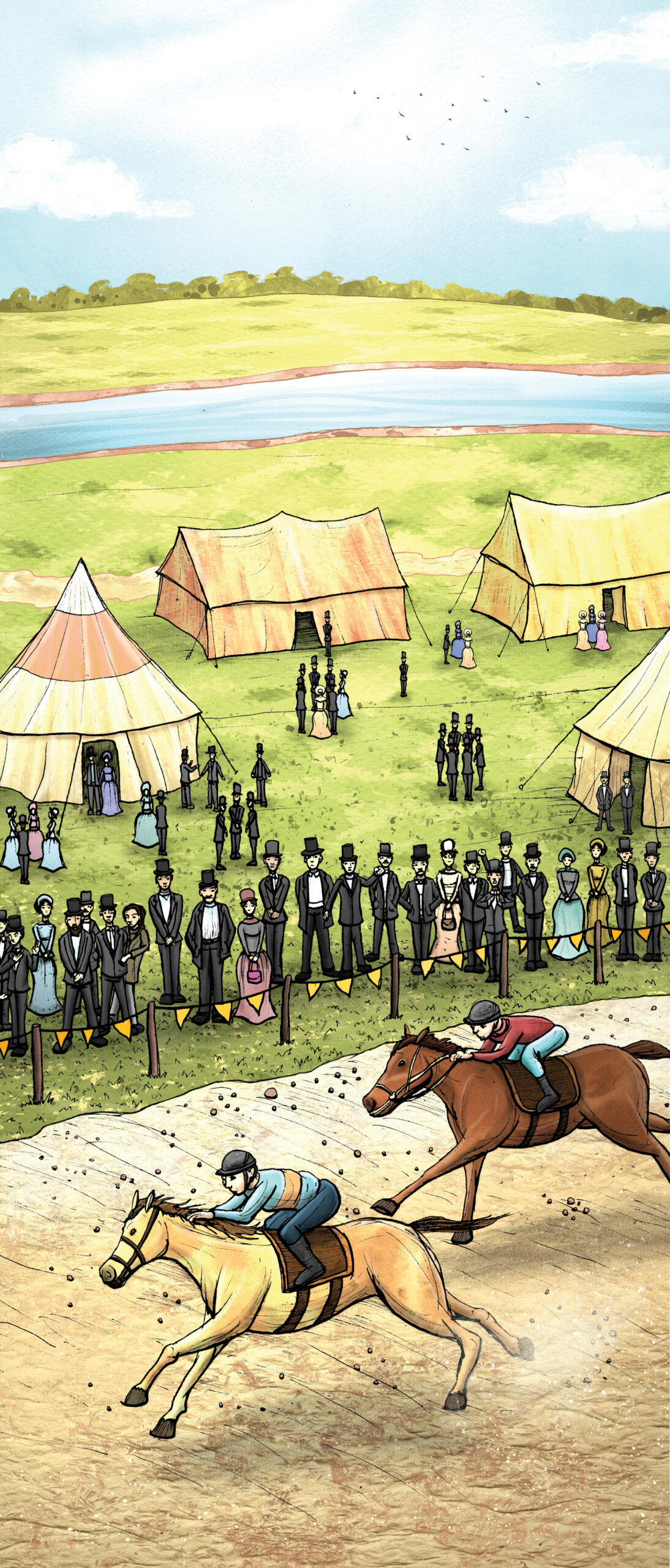
Horse racing was woven into the fabric of Georgian and Victorian society; at one point, there was a racecourse in almost every town in England. Described as ‘a place where different classes, sexes and ages mingled together in an atmosphere which encouraged the abandonment of social norms and customs’[1], race meetings created opportunities for the indulging of a range of activities, both directly associated with racing and others being there simply because of the presence of large numbers of people. Until further developments in commercialization of the sport towards the latter quarter of the Victorian Era, most race courses were open; only the wealthy were obliged to pay entry for their carriages and for the privileged access to the grandstand. Most attendees arrived on foot, even if this meant travelling considerable distances of up to fifteen miles.[2]
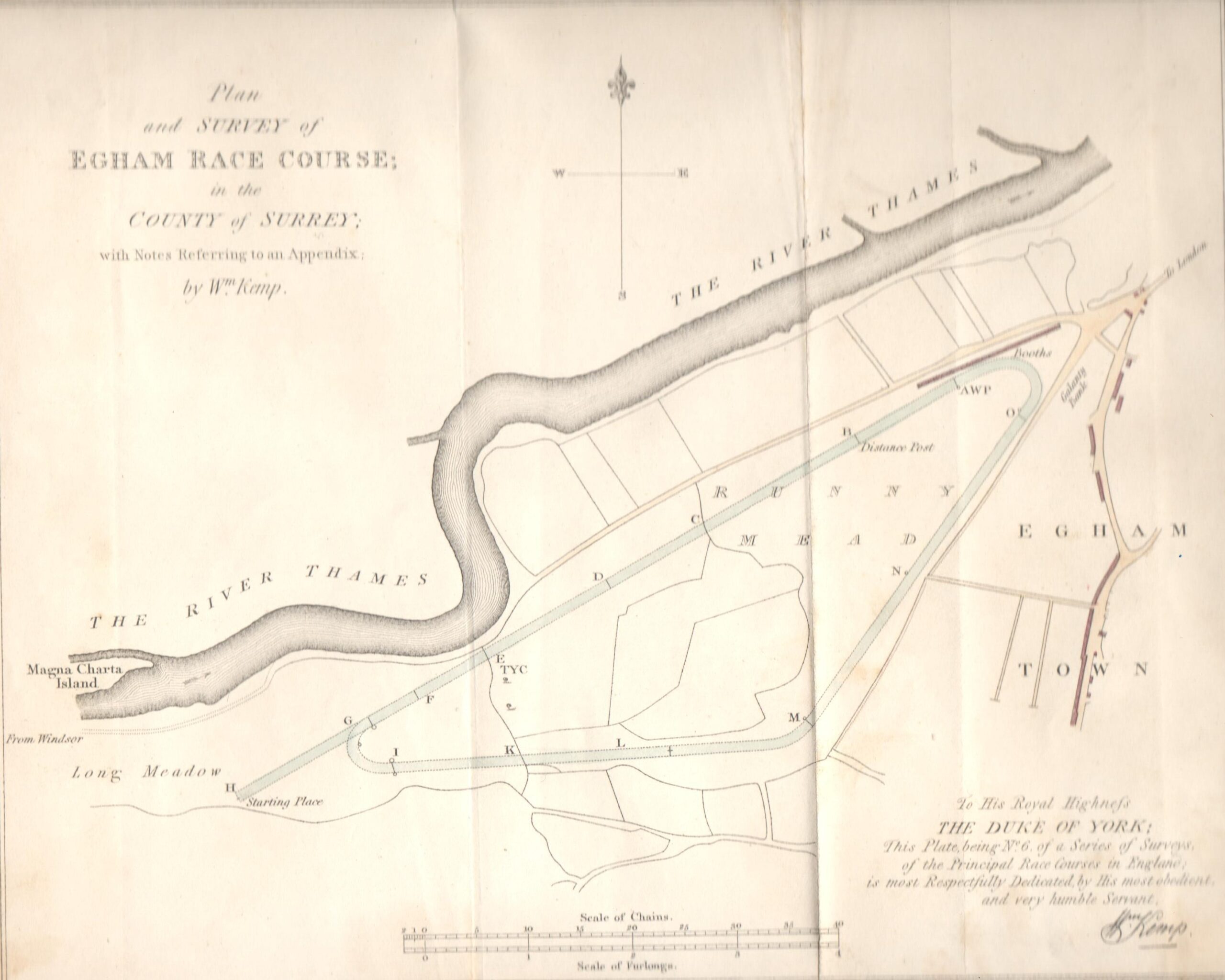
From the perspective of the authorities throughout the Georgian era, there was an ambivalence towards the race meeting; in the absence of professional police, such meetings provided potential for opportunistic crime and for the possibility of social disorder; in his study of the Egham races, Maurice Lord identifies a range of case studies where the wealthy racegoers were pickpocketed, even assaulted. Having no local professional police force until mid-19th century, in 1835, the race authorities at Egham even hired officers from Bow Street station (Metropolitan Police).[3] Despite the concerns of the authorities however, horse racing flourished directly as a result of elite even royal patronage.
Indeed, royal support was vital to the survival of Egham races; as the race course lay within the boundary of the Crown Estate, William 4th, a keen patron of the meetings there, ordered the area ‘to be thrown open’, effectively preventing enclosure and therefore the survival of the open race course.[4] As the most important form of mass entertainment before the impact of the railways, racing was integral to the social calendar of high society, for the opportunity of interaction between societal peers such as the ball held at its culmination, where ‘county society’ operated as a ‘coherent and vibrant social group’.[5] Races were also an important, if temporary, source of income for local tradesmen. Even as the Industrial Revolution progressed, much of Britain remained, as it had always been, an essentially rural society where patterns of behaviour and social deference informed by a mutual understanding was reinforced by visible cross class interaction; those who enforced law and order on the labouring classes were also the employer, local magistrate and distributor of charity.[6] Social control was therefore nuanced, more personalised and, for the preservation of inter class relations, there must have therefore been a high level of tolerance towards licentious behaviour .
By the middle of the 19th century, the development of the railway network across Victorian Britain had a transformative impact on horse racing as, indeed, it had on society in general. The railway made possible the gathering of much larger crowds, placing rural race courses such as Egham, for example, within a day’s travel to a far wider spectator audience. It also increased opportunities for horses to be entered for meetings in a range of courses up and down the country. Late Victorian entrepreneurs seeing the potential in commercialised horse racing, established limited liability companies to control and manage race courses which opened on or near railway stations. The latter would be key to their success.
Kempton Park set up by the investor Samuel Hyde, included a dedicated railway station built on a branch line to London Waterloo and, which opened on the same day as the race course on 18th July 1878. Gatwick, opened in 1891, beside the London- Brighton railway line also had a dedicated station complete with sidings for carriages carrying race horses. What these enterprises had in common was that they were enclosed. Enclosure now made possible an innovation beginning with the opening of Sandown Park race course in 1875; entry was now restricted to those who paid.[7] Even though it has been shown that the entry fee- Sandown was, initially, half a crown and Kempton park a shilling- was well within the disposable income of most adult men, the effect of enclosure had an adverse, sometimes considerable, effect on numbers attending.[8]
The survival of the Egham Race Course from being enclosed for farmland, by royal intervention in 1836, had, by the latter part of the century, now created a barrier to its continued survival. The problem of criminality which had always been a public nuisance on the pre railway era race course only became worse. Even in 1835, twenty years before the arrival of the railway to Egham, the race authorities had found it necessary to bring in professional police from the Metropolis to control anticipated arrival of London gangs. With the opening of the station from 1856 however, the problem of theft and assault at the race course reportedly worsened; ‘by 1867 respectable spectators had to take refuge in the stands to avoid being subjected to all manner of indignities.’[9] However, race meetings at Egham which had considerable local support continued to be held for another seventeen years, ending only abruptly in 1884. Indeed, so enraged were the local publicans at the sudden loss of business that for the four race committee members whom they deemed most responsible for the cancellation of the 1884 races, they burned effigies of them in an old farm wagon.[10]
The cessation of the race meeting at Egham needs to be placed within a broader context of later Victorian society. The greater tolerance of the risk and, indeed, pervasion of criminality in the public space which had previously characterised the relationship between social elites and others was being replaced by a formal professionalisation of the forces of law and order. By the 1880s, social order in the public space was now being maintained not by delicately maintained relationships between different social classes but by disinterested uniformed police and, in the case of the Egham races, not by the local constabulary but by the Metropolitan Police, for whose services the race committee were required to pay. Was the 1884 meeting cancelled because police refused to send officers, or was it because the race committee failed to raise sufficient funds to pay for the necessary police?[11]
Lord also infers the impact of the railways as the catalyst for the eventual demise of the Egham races simply because of the increase of criminal elements in attendance, citing the problem posed by London thieves. Indeed, growing concern over the potential for criminality at race courses within the London area specifically led to parliamentary action with the requirement that race meetings within a radius of ten miles of Charing Cross now required authorisation by a magistrate. This may inadvertently have pushed London gangs further afield towards meetings outside of the regulated area such as Egham, thereby exacerbating crime there.[12] By the 1880s, this could have increased policing costs and even the reluctance of the Metropolitan Police to set aside the necessary resources. Whatever may have been the real answer, the dependence now on the willingness of outside agencies to provide the resources for which the local authorities were required to pay was also a subtle means by which mass, especially working class dominated entertainment, could be managed and even censored.
There is, however, another explanation for the demise of open race courses such as at Egham. The early commercialisation and, indeed professionalisation of horse racing notwithstanding, from the mid 1870s these same developments were, as in other spectator sports, accelerating. Increasingly, survival of the race course was dependent on the ability to raise large amounts of capital; to provide the necessary start-up capital to establish the new racecourse at Kempton Park, Samuel Hyde raised £30 000 (modern equivalent of over £4.5 million) by issuing £50 shares, hence the growing adoption of limited liability by race courses during this period.[13] Increasingly, suburban race courses such as Egham, where from 1844, the number of days for the annual meeting was reduced from three to two, could not meet the growing additional costs.[14] For the newly enclosed and heavily capitalised race courses, It also made economic sense to impose, at least outwardly, a scene of public order, safety and control.
To conclude, as with so many open race courses, Egham failed because it had become obsolete in a maturing economy where public entertainment was now an opportunity for venture capitalism which brought with it its own requirements for outwardly acceptable behaviours maintained within an enclosed arena where admittance could be regulated.
[1] ‘Horse racing in 19th century Literature’, Jamie Wise, University of Chester MA thesis 2012
[2] Horse Racing and British Society in the Long 18th Century, (Boydell Press, Woodbridge, 2018); drawing on the adoption of a consensus on rules drawn up by the Jockey Club and the emergence of professional jockeys both developments in the 18th Century , Mike Huggins has challenged the assertion that commercialisation of sport was really a feature of the later 19th Century.
[3] Egham Races, 1734-1884, (Egham-by-Runnymede Historical Society, 1988), Maurice Lord, p.39
[4] Maurice Lord, p.41.
[5] ‘Town and Turf; The Development of Racing in England c1680-1760’, Peter Brorsay in ‘Life in the Georgian Town, Georgian Group Symposium 1985, pp.53-60.
[6] Social Control in 19th century Britain, edited by A.P. Donajgrodski, (Croom Helm Limited London 1977), p.22
[7] ‘United Race courses (holdings) Ltd: Records 1768-1984, Including Records of Epsom Grandstand Assn, 1768-[1969], Sandown Park, 1889-1968; Kempton Park, 1938, 1969; And United Racecourses, 1966-1968’; Surrey History Centre catalogue.
[8] Wise p.12. The figure for Sandown Park is from ‘United Race Courses (holdings Ltd’.
[9] M. Lord op.cit. pp.59-60
[10] Alfred Turner hand written note- ‘Egham Races’ Egham Museum Research Room, Doc 4131 D
[11] M. Lord, op. cit, p.62 or Turner, Doc 4131 D.
[12] ‘An Act for the Licensing of Metropolitan Suburban Racecourses’, 3rd July 1879.
[13] Sport, Economy and Society in Britain, 1750-1914, Neil Tranter,( CUP, 1988), p.20. See also Modern English Biography 6V, 1892-1921- entry for Samuel Henry Hyde written by F. Boase; British Library catalogue and database.
[14] M. Lord, op.cit, p.43.